
Categories
Browse insights across DeFi, stablecoins, RWAs, trading bots, regulations, and more.
Filter By:
Regulations

A fake Ledger app in Apple's App Store drained $9.5M from 50+ victims, CoW Swap's frontend was hijacked via DNS, and Hyperbridge lost $237K to a proof-replay exploit, all in a 12-day window that also saw Solana hit record on-chain metrics and South Korea table its most comprehensive crypto framework yet.
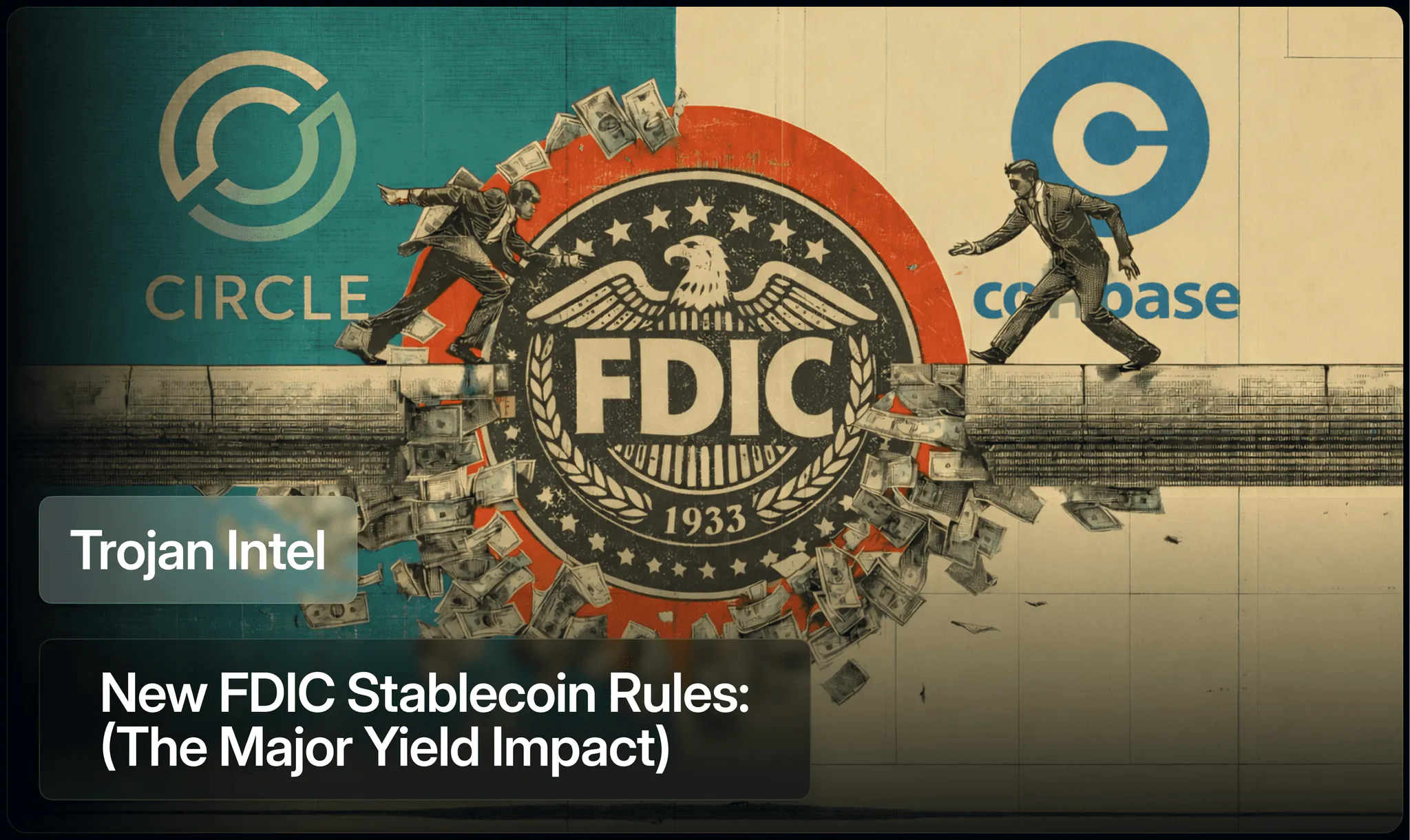
The FDIC's April 7, 2026 NPRM imposes strict 1:1 reserve, no-yield, and custody requirements on permitted payment stablecoin issuers under the GENIUS Act. It also clarifies that reserve deposits are not pass-through insured. The new no-yield ban puts the lucrative Circle-Coinbase revenue-sharing partnership directly in the crosshairs.

Solana's biggest DeFi hack of 2026 hit on April Fool's Day. Drift Protocol lost $285M to an admin key compromise with suspected DPRK links. The same week, the SEC/CFTC taxonomy gave SOL explicit commodity status, SoFi went live on Solana for enterprise banking, and the x402 Foundation launched with Solana driving 65% of its volume.

Corrective price week failed to slow institutional buildout. Wall Street's tokenized securities push gained its first regulatory green light. A major bank prepared to distribute Bitcoin through 16,000 advisors. Solana set back-to-back on-chain records. One compromised key at Resolv Labs was a reminder that audited code and intact collateral are no substitute for operational security.

The most significant regulatory development in crypto's history landed March 17: a joint SEC-CFTC interpretation ending securities ambiguity for Bitcoin, Ethereum, SOL, and 13 others. The same day, Phantom secured first-of-its-kind CFTC derivatives relief. Kraken put its Fed master account to work with live instant withdrawals, and Solana approved SIMD-0266 for April mainnet.
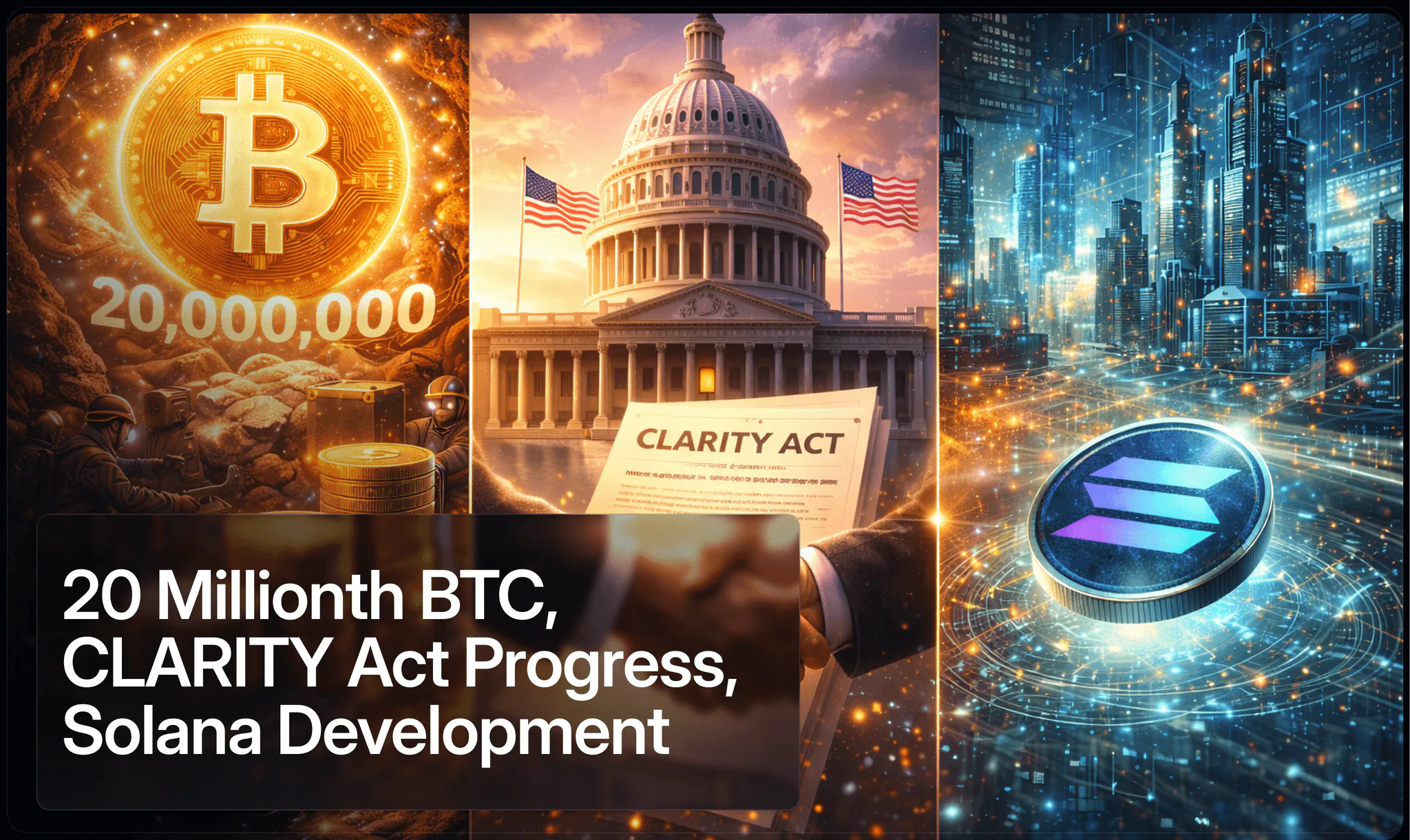
A week of macro turbulence and regulatory movement: the Clarity Act got a new compromise push from Sens. Alsobrooks and Tillis after the ABA rejected the White House's draft, Bitcoin crossed 20M mined at block 939,999, and Solana's ETF story deepened with Goldman Sachs and Electric Capital among confirmed Q4 institutional buyers.

U.S. and Israeli strikes on Iran sent Bitcoin to $63K before a partial recovery to $68K as equities absorbed the shock faster than expected. The CFTC installed a career federal prosecutor as enforcement chief, Magic Eden abandoned its multi-chain strategy entirely, and Solana continued a quiet but meaningful pivot from memecoins toward payments, RWAs, and infrastructure.
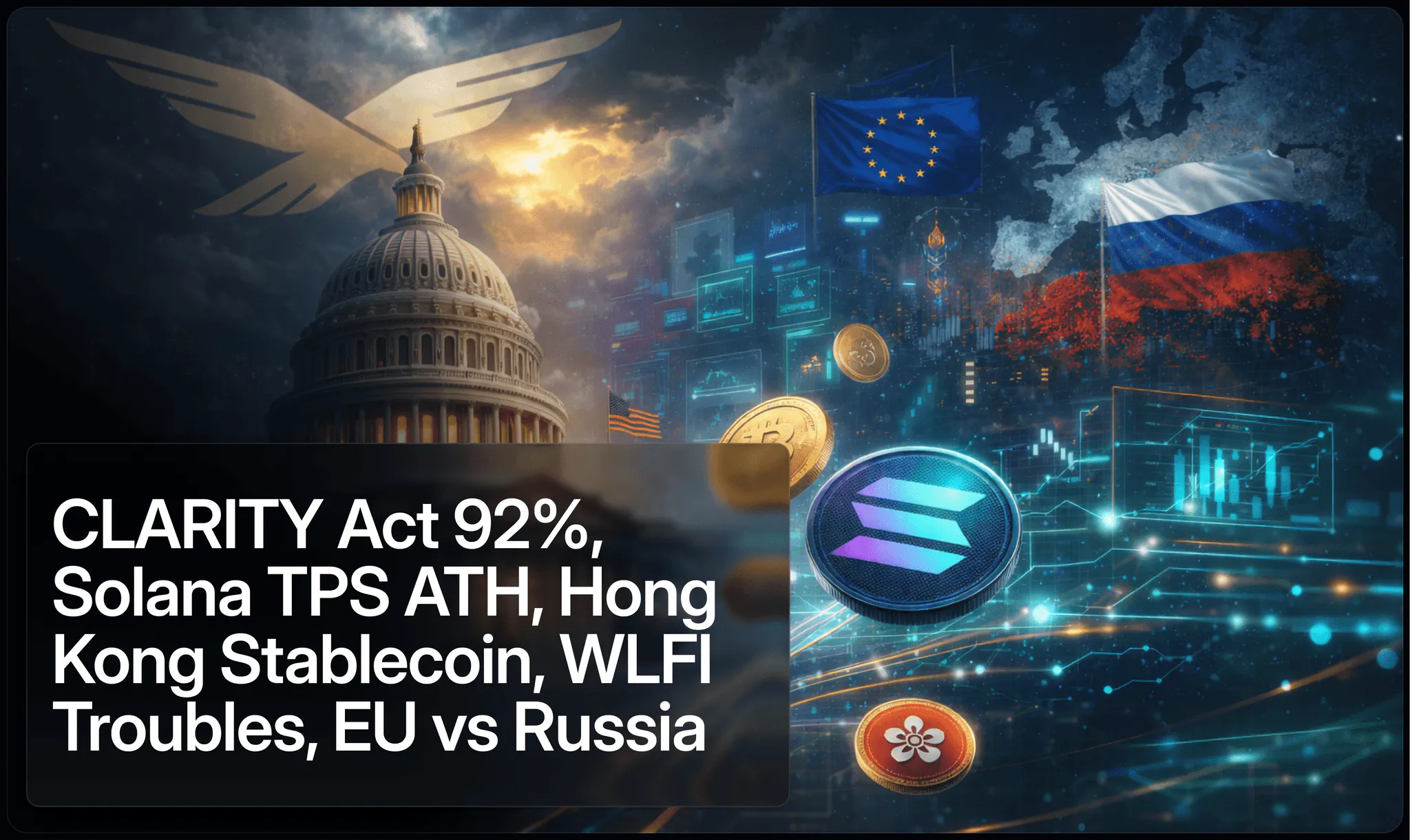
U.S. lawmakers pushed CLARITY Act odds toward passage as the SEC dropped major exchange cases and clarified meme coin status, while Solana hit new throughput highs and expanded RWA integrations. Hong Kong advanced stablecoin licensing as the EU tightened Russian linked crypto bans.

U.S. stablecoin negotiations advanced through high-level White House meetings as Solana rolled out Firedancer on mainnet and USD1 crossed new supply milestones. While macro volatility kept majors contained, memecoin rotation toward political and AI-driven narratives persisted, signaling that infrastructure, regulation, and speculative capital are evolving in parallel.
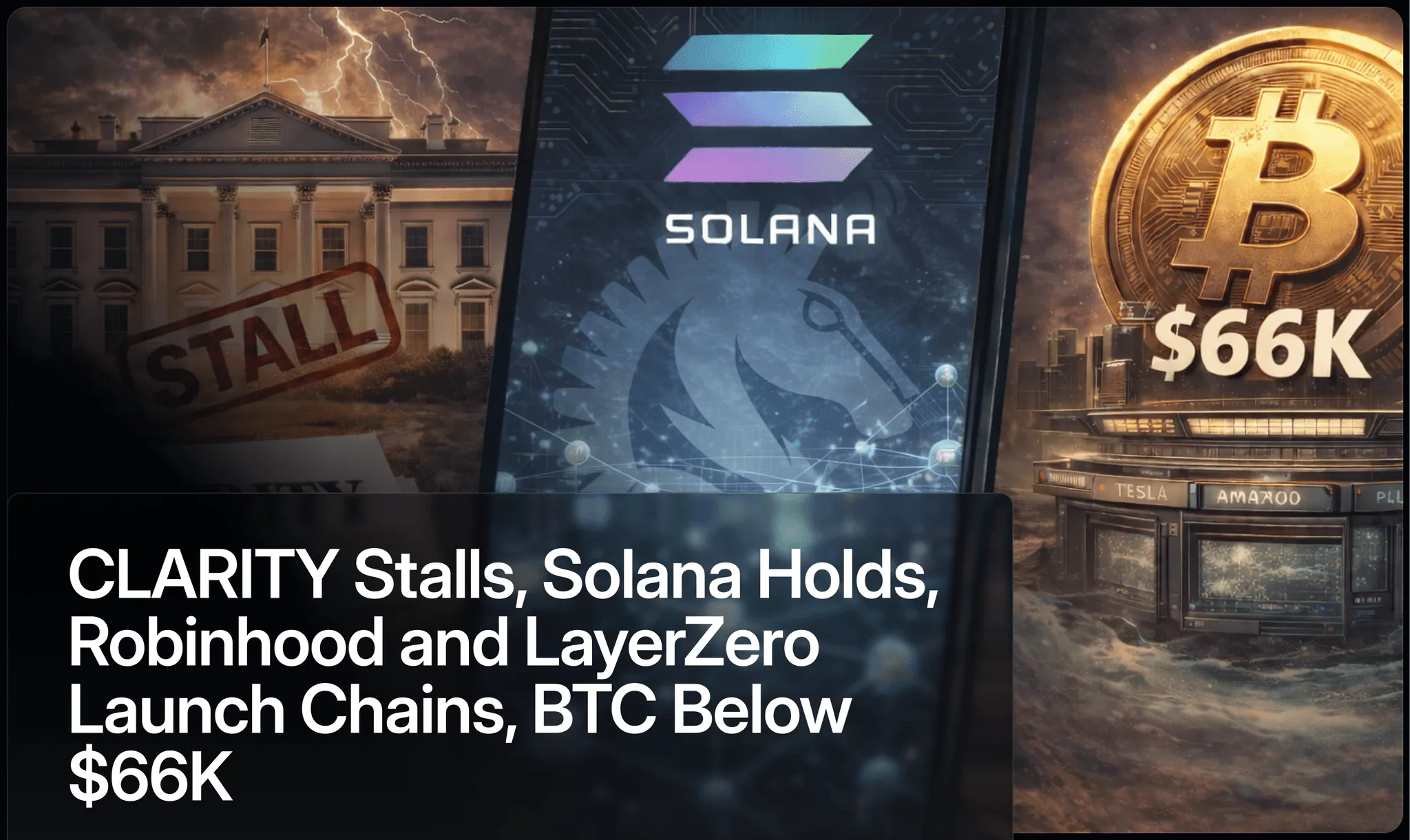
From February 7–12, markets chopped lower with Bitcoin hovering near $66K while White House crypto talks failed to resolve stablecoin disputes. Solana activity held steady, Robinhood launched an Arbitrum-based Layer-2 for tokenized equities, LayerZero unveiled a new institutional-grade Layer-1, and regulatory momentum continued despite political friction.

From February 2–6, Solana shipped new staking, institutional trading, privacy, and Accelerator initiatives despite a sharp market selloff. Bitcoin briefly fell below $61K amid ETF outflows and macro pressure, while U.S. lawmakers advanced market structure and stablecoin debates, widening the gap between price weakness and ecosystem buildout.

Over the past three days, Solana usage continued to climb through higher fees, address growth, USD1 expansion, and new infrastructure launches as Washington pushed forward on CLARITY Act negotiations. Markets sold off sharply on macro pressure, but memecoin rotation and onchain activity remained concentrated on Solana.

Crypto markets show signs of stabilizing as institutional players move deeper into blockchain. UBS readies Bitcoin trading for private clients, Ledger eyes a $4B NYSE IPO, and PwC calls crypto adoption “past the point of no return.” Solana continues to lead in network strength and partnerships, with Hanwha joining forces in Korea and new DeFi entrants like PinPet gearing up for launch.

Crypto markets cooled as Bitcoin retested support and the U.S. expanded its strategic Bitcoin reserve. The Clarity Act remains gridlocked, Solana’s RWA adoption hit new highs, and fresh policy from South Korea to Belarus pushed tokenization and crypto banking into the mainstream.

January 14, 2026 delivered a strong crypto rebound led by macro sentiment, institutional flows, and rising retail activity. Bitcoin and Ethereum advanced on dovish expectations, Solana maintained technical strength, meme coins reignited, and Russia advanced a major bill expanding retail crypto access.
The Clarity Act (H.R. 3633) aims to establish a unified U.S. framework for digital assets, distinguishing securities from commodities and clarifying oversight between the SEC and CFTC. With a Senate markup set for the end of January, the outcome could reshape the landscape for onchain markets and institutional participation.
A fake Ledger app in Apple's App Store drained $9.5M from 50+ victims, CoW Swap's frontend was hijacked via DNS, and Hyperbridge lost $237K to a proof-replay exploit, all in a 12-day window that also saw Solana hit record on-chain metrics and South Korea table its most comprehensive crypto framework yet.
The FDIC's April 7, 2026 NPRM imposes strict 1:1 reserve, no-yield, and custody requirements on permitted payment stablecoin issuers under the GENIUS Act. It also clarifies that reserve deposits are not pass-through insured. The new no-yield ban puts the lucrative Circle-Coinbase revenue-sharing partnership directly in the crosshairs.
Solana's biggest DeFi hack of 2026 hit on April Fool's Day. Drift Protocol lost $285M to an admin key compromise with suspected DPRK links. The same week, the SEC/CFTC taxonomy gave SOL explicit commodity status, SoFi went live on Solana for enterprise banking, and the x402 Foundation launched with Solana driving 65% of its volume.
Corrective price week failed to slow institutional buildout. Wall Street's tokenized securities push gained its first regulatory green light. A major bank prepared to distribute Bitcoin through 16,000 advisors. Solana set back-to-back on-chain records. One compromised key at Resolv Labs was a reminder that audited code and intact collateral are no substitute for operational security.
The most significant regulatory development in crypto's history landed March 17: a joint SEC-CFTC interpretation ending securities ambiguity for Bitcoin, Ethereum, SOL, and 13 others. The same day, Phantom secured first-of-its-kind CFTC derivatives relief. Kraken put its Fed master account to work with live instant withdrawals, and Solana approved SIMD-0266 for April mainnet.
A week of macro turbulence and regulatory movement: the Clarity Act got a new compromise push from Sens. Alsobrooks and Tillis after the ABA rejected the White House's draft, Bitcoin crossed 20M mined at block 939,999, and Solana's ETF story deepened with Goldman Sachs and Electric Capital among confirmed Q4 institutional buyers.
U.S. and Israeli strikes on Iran sent Bitcoin to $63K before a partial recovery to $68K as equities absorbed the shock faster than expected. The CFTC installed a career federal prosecutor as enforcement chief, Magic Eden abandoned its multi-chain strategy entirely, and Solana continued a quiet but meaningful pivot from memecoins toward payments, RWAs, and infrastructure.
U.S. lawmakers pushed CLARITY Act odds toward passage as the SEC dropped major exchange cases and clarified meme coin status, while Solana hit new throughput highs and expanded RWA integrations. Hong Kong advanced stablecoin licensing as the EU tightened Russian linked crypto bans.
U.S. stablecoin negotiations advanced through high-level White House meetings as Solana rolled out Firedancer on mainnet and USD1 crossed new supply milestones. While macro volatility kept majors contained, memecoin rotation toward political and AI-driven narratives persisted, signaling that infrastructure, regulation, and speculative capital are evolving in parallel.
From February 7–12, markets chopped lower with Bitcoin hovering near $66K while White House crypto talks failed to resolve stablecoin disputes. Solana activity held steady, Robinhood launched an Arbitrum-based Layer-2 for tokenized equities, LayerZero unveiled a new institutional-grade Layer-1, and regulatory momentum continued despite political friction.
From February 2–6, Solana shipped new staking, institutional trading, privacy, and Accelerator initiatives despite a sharp market selloff. Bitcoin briefly fell below $61K amid ETF outflows and macro pressure, while U.S. lawmakers advanced market structure and stablecoin debates, widening the gap between price weakness and ecosystem buildout.
Over the past three days, Solana usage continued to climb through higher fees, address growth, USD1 expansion, and new infrastructure launches as Washington pushed forward on CLARITY Act negotiations. Markets sold off sharply on macro pressure, but memecoin rotation and onchain activity remained concentrated on Solana.
Crypto markets show signs of stabilizing as institutional players move deeper into blockchain. UBS readies Bitcoin trading for private clients, Ledger eyes a $4B NYSE IPO, and PwC calls crypto adoption “past the point of no return.” Solana continues to lead in network strength and partnerships, with Hanwha joining forces in Korea and new DeFi entrants like PinPet gearing up for launch.
Crypto markets cooled as Bitcoin retested support and the U.S. expanded its strategic Bitcoin reserve. The Clarity Act remains gridlocked, Solana’s RWA adoption hit new highs, and fresh policy from South Korea to Belarus pushed tokenization and crypto banking into the mainstream.
January 14, 2026 delivered a strong crypto rebound led by macro sentiment, institutional flows, and rising retail activity. Bitcoin and Ethereum advanced on dovish expectations, Solana maintained technical strength, meme coins reignited, and Russia advanced a major bill expanding retail crypto access.
The Clarity Act (H.R. 3633) aims to establish a unified U.S. framework for digital assets, distinguishing securities from commodities and clarifying oversight between the SEC and CFTC. With a Senate markup set for the end of January, the outcome could reshape the landscape for onchain markets and institutional participation.

© 2025 Trojan Trading. All rights reserved.
Systems Operational